
Criminal Cases in the Fairfield County Courts
Fairfield County criminal cases do not all go to one court. The Court of General Sessions, part of the Sixth Judicial Circuit, has general criminal jurisdiction for matters beyond the summary courts. The Clerk of Court keeps those case files and bond records at 101 South Congress Street in Winnsboro. Fairfield Magistrate Court handles summary criminal and traffic matters, preliminary hearings, and county warrant and bond work at 115-B South Congress Street. A preliminary hearing in a General Sessions matter may begin there even though the felony file belongs with the circuit clerk.
Winnsboro and Ridgeway also maintain municipal dockets for town ordinance, traffic, and other matters within summary jurisdiction. Winnsboro Municipal Court is at 117 West Washington Street. Ridgeway Municipal Court is at 170 South Dogwood Avenue. Both appeared on the Judicial Branch list of municipal courts participating in statewide case management as of December 2025, but a missing online entry should still be checked with the town clerk. The court that heard the case controls where the official record rests.
Fairfield County Criminal Court Map
Start by matching the charge and location to the court. General Sessions files use the county clerk, while lower-level matters can remain with a magistrate or municipal clerk. The county clerk describes General Sessions as the court of general criminal jurisdiction except for most misdemeanors, which usually begin in Magistrate Court. An offense-specific law, transfer, or election can change that result, so the docket heading is a better guide than a guess based on the charge name.
Fairfield Clerk of Court
101 S. Congress St.
PO Drawer 299
Winnsboro, SC 29180-0299
803-712-6526
Monday through Friday, 9 a.m. to 5 p.m.
Fairfield Magistrate Court
115-B S. Congress St.
Winnsboro, SC 29180-1103
803-635-4525
Monday through Friday, 9 a.m. to 5 p.m.; closed 12:30 to 1:30 p.m.
Note: Call before a courthouse visit because renovation work has changed office access and locations during recent phases.
How to Search Case Records
The South Carolina Judicial Branch Case Records Search is the stable statewide starting point. It routes users to each county index. The Fairfield Public Index is the direct local search. The Judicial Branch warns that cookies and JavaScript must be enabled and that a popup exception may be needed. Search results are informational. They do not replace a clerk-certified copy.
- Open the state gateway or Fairfield County Public Index and choose the criminal or General Sessions docket that fits the record.
- Enter the case number when known. Otherwise, search a party name and use spelling variants to avoid a false miss.
- Narrow the results by court agency, case type, or a filing and event date window where those controls appear.
- Open the matching docket and compare court, filing date, charges, events, disposition, and sentence rather than relying on a name alone.
- Record the case number and call the proper clerk for pleadings, certified copies, older files, or any document not shown online.
| Field or Control | Type | Required | Use |
|---|---|---|---|
| Case Number | Text | No | Best precise key when known |
| Party Name | Text fields | No | Try careful spelling variants |
| Court Agency | Selector | No | Narrows the court or agency |
| Case Type | Selector | No | Targets the criminal or General Sessions docket |
| Date Range | Date fields | No | Limits the filing or event window |
| Search / Clear | Buttons | Not applicable | Runs or resets the query |
The official legacy Fairfield search screen shows the form used for county case access.
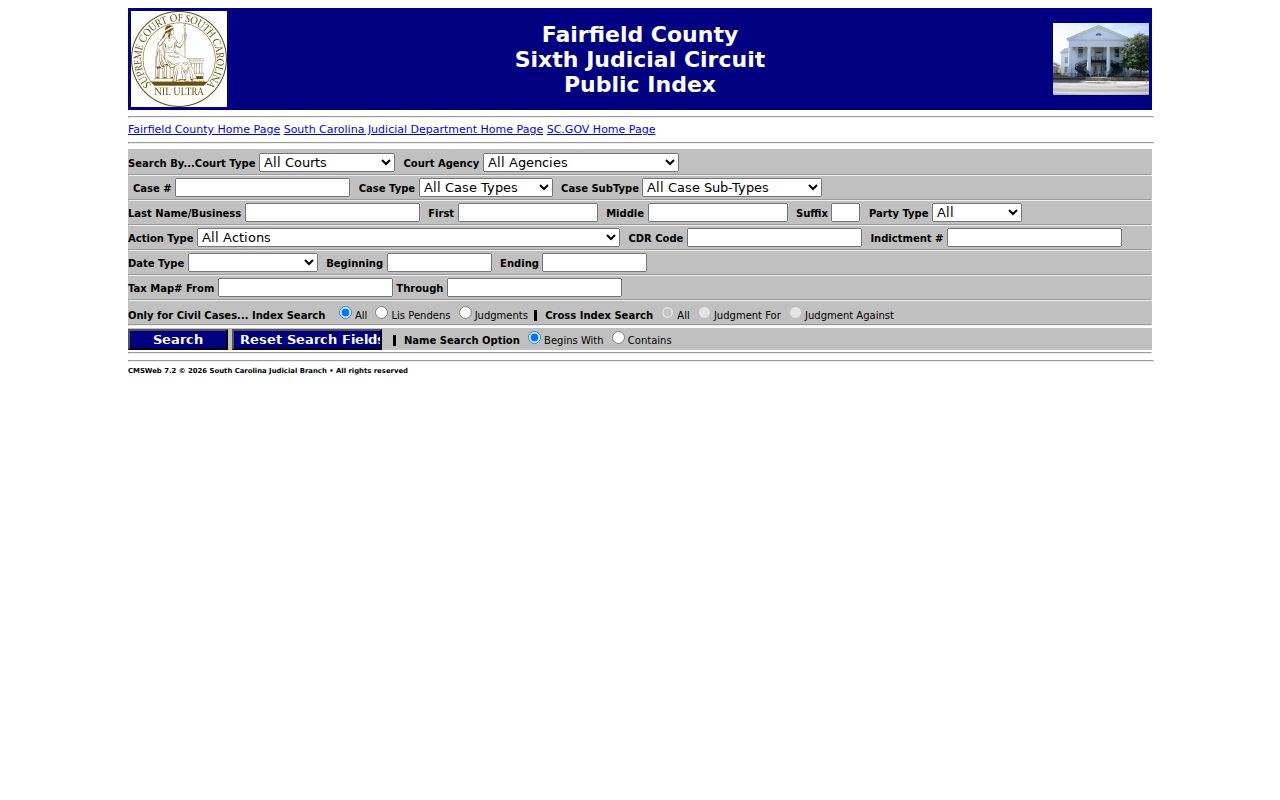
Use the state gateway if a saved deep link changes, then return to the Fairfield County selection.
Read Fairfield County Case Numbers
Case numbers can show which kind of file is on screen. Official Public Index help describes General Sessions and Common Pleas numbers as a year, the court type code GS or CP, the county code, and a five-digit identifier. Summary Court numbers use a year, the letter A, the county code, and an eight-digit identifier. That pattern helps separate a General Sessions charge from a summary matter when a person has more than one entry.
The code is a locator, not an outcome. Read the docket events and disposition. A charge at arrest may be amended, dismissed, or replaced by the solicitor before the final court record is complete. The jail intake label, charging instrument, and final judgment can therefore differ without any one of them being a duplicate. When two entries appear related, give both numbers to the clerk and ask which file holds the signed order.
What the Case File Shows
A Fairfield County criminal case file follows the filed prosecution, not just the initial arrest. A typical official docket can identify the court and case, show filing and hearing events, list the charge as it changes, and record the disposition and sentence. Dynamic portal fields can change, so the inventory below states the record categories supported by county research rather than promising that every item appears in every online view.
| Case Number and Court | Identifies the docket, court level, and file used for clerk requests. |
|---|---|
| Charging Paper | Shows the warrant, indictment, ticket, or other filed accusation when publicly available. |
| Docket Events | Tracks filings, roster activity, hearings, motions, and orders entered in the case. |
| Parties and Counsel | Names the prosecuted party and may identify attorneys, subject to public display rules. |
| Disposition | States how the filed charge ended, such as plea, conviction, dismissal, acquittal, or nolle prosequi where used. |
| Sentence | Records the court's punishment and conditions when a sentence was imposed. |
For the wider record chain before a case reaches court, Fairfield County arrest history records explain the agency and booking layers.
Certified Fairfield County Court Records
An online result is not the certified Fairfield County court record. Save the case number, identify the court, and call its clerk before ordering. The Clerk of Court can address General Sessions documents, older material, and certification. No official Fairfield County copy or certification fee schedule was found in the research, so ask the clerk for the current price, accepted payment, and delivery options. The same caution applies to municipal and magistrate files.
The Fairfield Public Index landing page is the best visual check that the county search is selected.
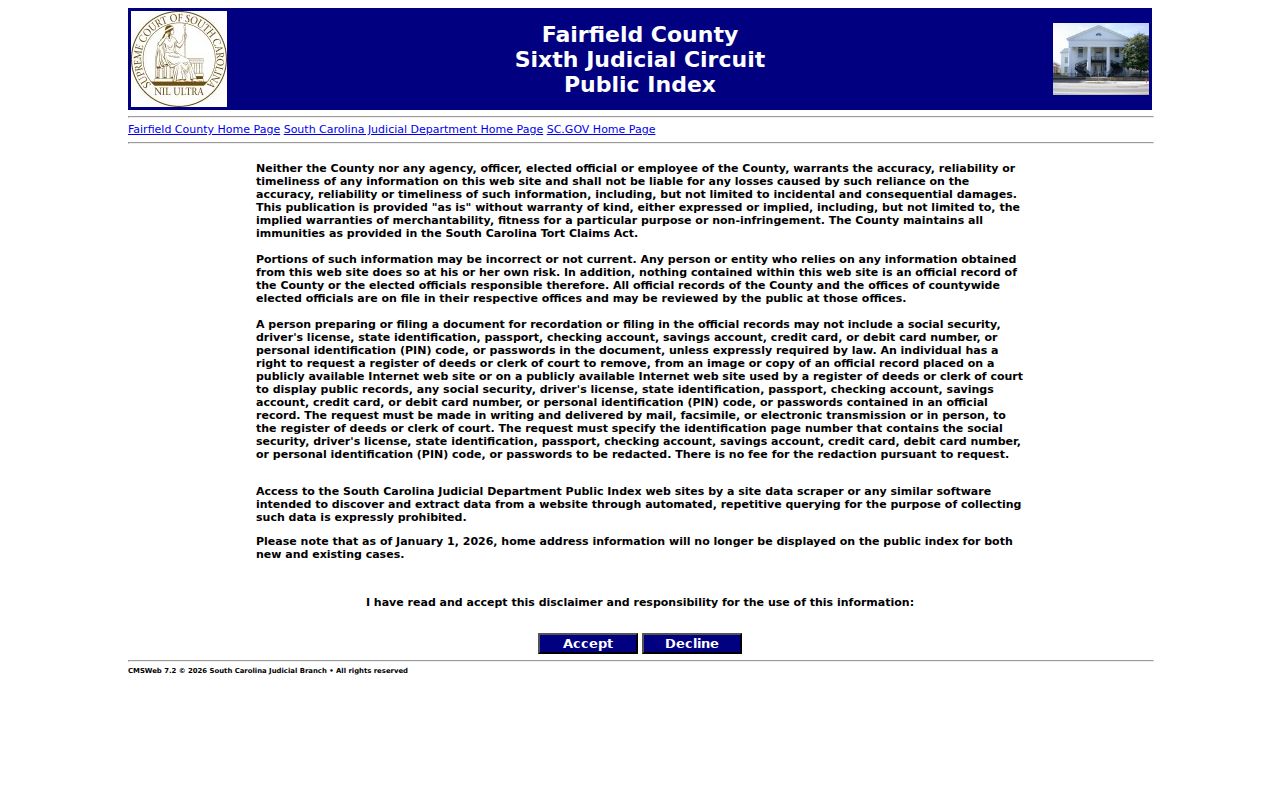
The public screen helps locate the file, while the clerk remains the source for an official certified copy.
Note: Quote the court and full case number when asking for a copy so staff can locate the right docket.
Stages of a Criminal Case
A Fairfield County court file changes as the case moves. An arrest charge may reach a magistrate for the initial proceeding and bond. The solicitor then decides what to file in General Sessions, and the case can move through arraignment, pretrial motions, negotiation, or trial. A preliminary-hearing request form obtained at bond court must be returned to the named court within ten days. Missing that local deadline can affect whether the hearing is held.
Case flow: Charges Filed → Arraignment → Pretrial → Plea or Trial → Disposition → Sentencing
A release from detention does not end the docket. Likewise, a charge shown at intake may not match the final indictment. Follow the event history through disposition, then confirm the signed judgment with the clerk if the result will be relied on for a personal record review or case analysis.
Fairfield County Case Address Redactions
Beginning January 1, 2026, the South Carolina Public Index stopped displaying home-address information for new and existing public-index cases. A current Fairfield County case search can therefore look less detailed than an old saved result without indicating that the whole file was sealed. The change limits one field in public display. It does not by itself erase the docket, charge, disposition, or sentence.
This distinction matters when a searcher tries to confirm identity. Do not substitute a home address from an old web cache or outside people-search source. Compare lawful identifiers in the official file and ask the clerk what public information can be used to distinguish similar names. Court staff may also explain whether a record is public but unavailable online, as opposed to sealed or expunged.
Historic Fairfield County Criminal Case Journals
Modern Public Index searches are not the only route for old Fairfield County criminal records. The South Carolina Archives' official county guide inventories General Sessions criminal journals from 1840 through 1903, rough criminal journals from 1800 through 1907, indictments dating roughly from 1800 through 1925, and criminal dockets from 1867 through 1908. Magistrate dockets and sheriff jail or writ books also survive in the archival inventory.
Those sources suit genealogy and research into how the Fairfield County justice system worked before electronic dockets. They are not substitutes for a modern case-status check. Begin with the archive's series description, note the date and court, and then ask what volume or reel holds the entry. For a current criminal matter, use the county Public Index and the responsible clerk instead.
Access & Restrictions
South Carolina's court procedures, not county FOIA alone, govern access to judicial case files. Public Fairfield County dockets may still omit juvenile matters, sealed or expunged cases, victim-identifying data, and other information protected by law or court order. An absent record is not proof that no proceeding occurred. It may sit in another court, predate online coverage, be too new to display, or be lawfully restricted.
South Carolina FOIA supports access to public-body records, but judicial records follow clerk and court rules. Ask for a segregable public portion when protected details can be redacted.
The county's courthouse renovation notice documents why a current phone check is wise before visiting a records counter.
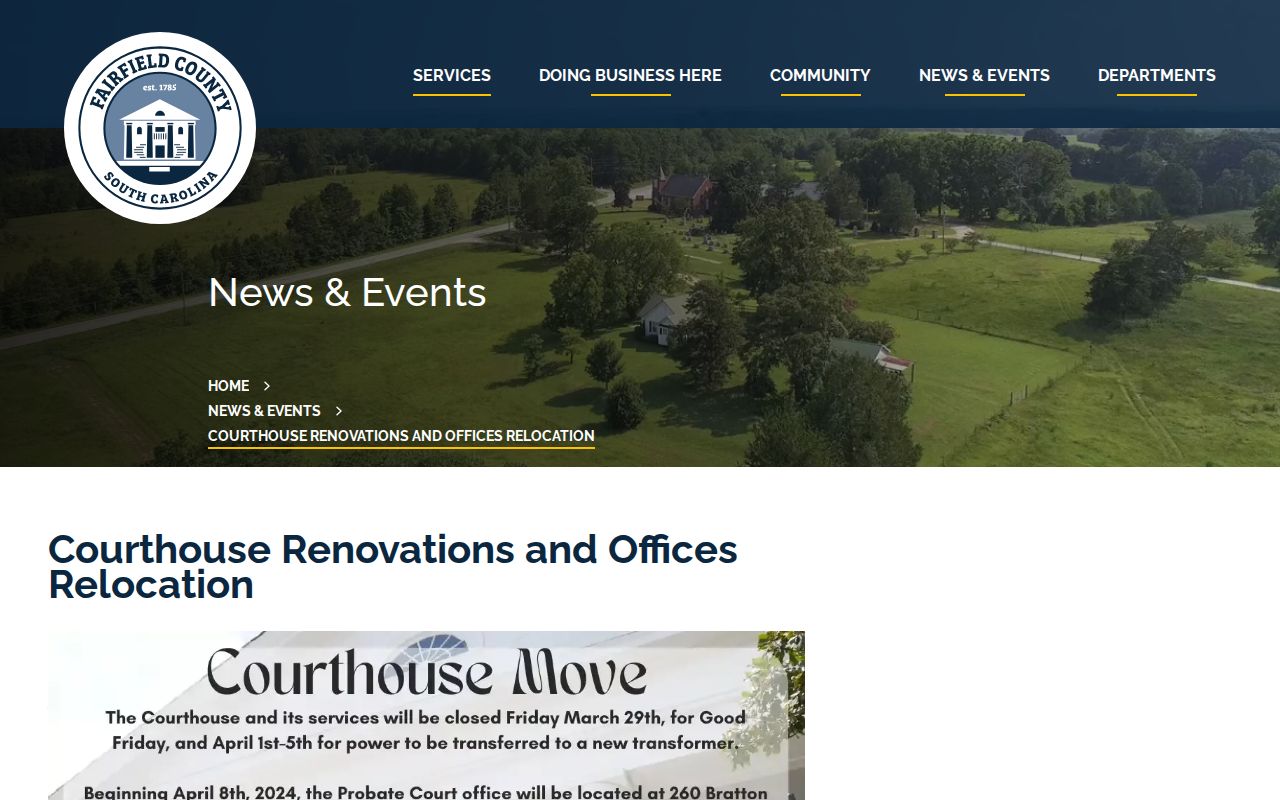
Temporary office moves can affect the entrance or counter even when the court's legal role stays the same.